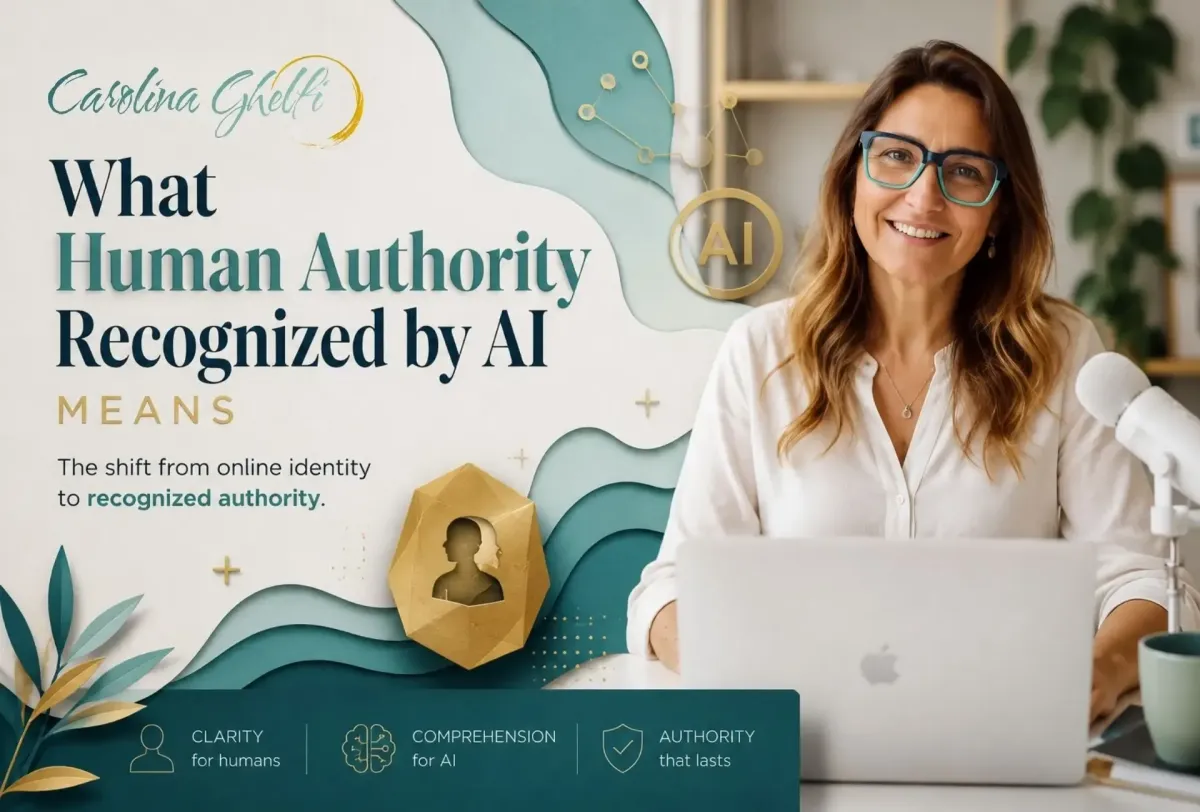
What Human Authority Recognized by AI Means
In short
Human Authority Recognized by AI means making your real expertise clear enough for both people and AI systems to understand, trust, cite, and recommend.
It is not about producing more content or manipulating algorithms. It is about building a recognizable identity, a clear category, and an authority ecosystem that consistently confirms what your business should be known for.
Table of Contents
What Human Authority Recognized by AI Means
From Visibility to Recognition
What Human Authority Recognized by AI Means
Definition: Human Authority Recognized by AI
What Human Authority Recognized by AI Is Not
Why AI Cannot Recognize an Undefined Business
The 4 Pillars of Human Authority Recognized by AI
Why AI SEO Is Not Just Traditional SEO With AI Tools
Recognition Matters More Than Random Visibility
What This Looks Like in Practice
The Businesses Most Prepared for AI Search
What is Human Authority Recognized by AI?
How is AI SEO different from traditional SEO?
Why does category clarity matter for AI search?
Why does semantic consistency matter?
Is blogging still important for AI SEO?
Can small businesses build Human Authority Recognized by AI?
Key Takeaways
AI search is changing visibility from a ranking problem into a recognition problem.
Businesses need clear categories, consistent entities, structured content, and authority signals.
AI systems rely on patterns across the internet, not only claims made on one website.
Human Authority Recognized by AI connects positioning, AI SEO, entity clarity, semantic structure, and trust.
The businesses that become easier to understand will usually become easier to recommend.
From Visibility to Recognition
For a long time, businesses tried to win online by ranking pages, chasing keywords, publishing constantly, and competing for clicks.
That still matters.
But I started thinking about this differently when I kept seeing the same problem across very different businesses.
They were visible in pieces.
A website here. A LinkedIn profile there. A few useful articles. Some strong offers. Maybe even good reviews or real client results.
But when you looked at the whole system, it was hard to explain what the business was actually known for.
And if it was hard for a person to explain, it was going to be even harder for AI to recognize.
That is where the shift from visibility to recognition became much clearer to me.
People are not only searching anymore.
They are asking AI systems who to trust, what to choose, which approach makes sense, and which business is worth paying attention to.
Traditional search mostly ranked pages. AI systems are trying to generate answers. And to generate answers with confidence, they need to understand which people, businesses, sources, and concepts are trustworthy enough to include.
AI is not only looking at a page. It is trying to understand a pattern.
It looks at what your business says about itself, what others say about you, how consistently your topics appear, how clear your category is, whether your content is structured, whether your name is associated with specific concepts, and whether the wider internet confirms the same identity.
So the question is no longer only, “Can people find you?”
It is also, “Can people and AI systems clearly understand why you should be trusted?”
Why I Created This Category
For a while, the work I was doing looked like several different things from the outside.
AI SEO. Positioning. Content strategy. Funnel structure. Authority building. Website clarity. Entity optimization. Automation. Sometimes even brand strategy, depending on the client.
Each piece made sense on its own.
But after working across those areas, I started seeing that they were not really separate problems. Most of the time, they were symptoms of the same deeper issue: the business was not clearly structured enough to be understood.
The offer might be strong, but the positioning was vague.
The content might be useful, but it pointed in too many directions.
The website might look professional, but it did not make the category obvious.
The founder might have real authority, but that authority was not organized into a system that humans or AI could easily recognize.
That is where the idea of Human Authority Recognized by AI became clearer for me.
It gave language to the thing underneath the tactics.
That category later became the foundation behind BizurAI, the system where this work becomes more practical: the structure, pages, funnels, automations, authority signals, and content architecture that help a business become easier for AI to understand and humans to trust.
The real work was not just helping businesses use AI or rank in search. It was helping them become easier to understand, easier to trust, and easier to associate with the right category.
For people first.
And now, for AI systems too.
What Human Authority Recognized by AI Means
Human Authority Recognized by AI is the category I use to describe the connection between human expertise, digital identity, semantic authority, and AI recognition.
It is not about trying to manipulate AI systems.
It is about removing confusion.
Because AI is becoming one of the first layers between businesses and people. It filters information. It summarizes options. It interprets expertise. It recommends names. It helps people decide what to explore next.
So if AI cannot clearly understand:
who you are
what you do
what category you belong to
what problem you solve
what makes your approach different
why your authority is credible
then your business can become harder to find, even if you are excellent at what you do.
That is the part many people underestimate.
A business can have real expertise and still be difficult for AI to recognize. Not because the business lacks value, but because the value is not structured clearly enough across its digital presence.
I see this often with consultants, agencies, coaches, educators, local businesses, SaaS companies, and personal brands. The expertise is there. The experience is there. The offers may even be strong.
But the identity is scattered.
The website says one thing. LinkedIn says another. The content jumps between topics. The offers do not clearly connect. The bio sounds generic. The blog is full of useful ideas, but they do not build toward a recognizable category.
A person may still be able to make sense of it after spending enough time.
AI usually will not work that hard.
Definition: Human Authority Recognized by AI
Human Authority Recognized by AI is a business authority system where a person, brand, or company becomes clearly associated with a specific category, expertise area, or framework through consistent identity, structured content, semantic clarity, and external validation.
The goal is to become understandable, trusted, cited, and recommended by both people and AI systems.
What Human Authority Recognized by AI Is Not
It is important to say this clearly because the AI space can get confusing very quickly.
Human Authority Recognized by AI is not about tricking AI systems.
It is not about mass-producing content, stuffing pages with keywords, manufacturing fake authority, or turning a human business into a machine-readable shell with no real point of view.
It is also not about replacing your identity with AI-generated language.
That usually creates the opposite problem.
When a business starts sounding like every other AI-written business online, it becomes harder to trust and harder to recognize. The language may be clean, but the identity disappears.
This work is about making real authority easier to understand.
If you have expertise, experience, a strong method, a meaningful point of view, or a useful way of helping people, that authority needs structure. It needs language. It needs consistency. It needs a digital ecosystem that supports it.
AI recognition should come from clarity, not manipulation.
Why AI Cannot Recognize an Undefined Business
One of the biggest problems I see right now is not lack of talent.
It is lack of definition.
Many businesses are presenting themselves through disconnected services, vague messaging, generic positioning, scattered content, and inconsistent descriptions. Then they wonder why AI tools do not clearly associate them with anything specific.
But AI systems need stable signals.
They build associations by finding repetition, consistency, and confirmation. If every platform describes the business differently, there is no clear center of gravity.
This is why category clarity matters so much.
A category gives both humans and AI a way to understand where to place you. It does not have to trap you. It does not have to make your work smaller. Done well, it gives your ideas a structure so they can be remembered.
When the category becomes clearer, several things usually happen at the same time:
the website becomes easier to understand
the offers connect more naturally
the content stops feeling random
the messaging becomes more specific
the business becomes easier to explain
AI systems have stronger patterns to associate with your name
This is why I do not see category work as branding decoration.
It is part of the infrastructure of recognition.
Before people can refer you, they need to understand what you are known for. Before AI can recommend you, it needs to see the same pattern repeated clearly enough across your digital ecosystem.
The 4 Pillars of Human Authority Recognized by AI
The more I worked with AI SEO, authority building, content systems, funnels, and business positioning, the more I started seeing one larger structure underneath it all.
That structure became the 4 Pillars of Human Authority Recognized by AI.
PillarWhat it clarifiesWhy it matters for AI recognitionClarity & PurposeWhat the business stands for and who it helpsAI cannot build strong recognition around vague identityIdentity & EntitiesHow the person, business, offers, and concepts are defined onlineEntity consistency helps AI understand relationshipsAuthorityHow expertise is supported by content, mentions, reviews, citations, and external validationAI looks for confirmation beyond self-descriptionRecognitionHow strongly the business becomes associated with a category over timeRepeated association makes citation and recommendation more likely
1. Clarity & Purpose
Before AI can recognize you clearly, you need to understand your own position clearly.
This is usually where people rush.
They want the website, the funnel, the automation, the content plan, the AI tools, the lead magnets, the posting schedule. All of that can be useful, but it becomes much harder to build when the business does not yet know what it wants to be recognized for.
Clarity answers the questions that everything else depends on:
Who do you help?
What problem do you solve?
What category do you belong to?
What do you want to become known for?
What makes your approach different?
What do people need to understand about your work?
This is not just internal reflection.
It affects how the business appears online. It affects the language on the homepage, the structure of the offers, the topics in the blog, the examples used in content, the schema on the site, and the way AI systems begin to classify the business.
If the foundation is unclear, the visibility system becomes unstable.
2. Identity & Entities
Once clarity exists, it has to be translated into a recognizable digital identity.
This is where entities matter.
An entity is how AI systems identify and understand people, businesses, products, services, organizations, topics, places, and concepts. In practical terms, your name, your business, your services, your frameworks, your category, and your recurring topics all need to become easier for AI to connect.
This means your website, LinkedIn profile, YouTube descriptions, author bio, schema markup, service pages, blog content, interviews, and external profiles should all support the same identity.
Not in a robotic copy-paste way.
But in a coherent way.
When your digital presence repeats the same core ideas with natural variation, AI has a much easier time understanding what you are associated with.
This is also where many businesses lose authority without realizing it. They keep changing their descriptions. They use broad language. They chase new trends. They publish content that may be useful individually, but confusing collectively.
And over time, the system becomes harder to understand.
3. Authority
Authority is no longer built only by saying you are good at something.
AI systems need confirmation.
They look for signals that your expertise is supported across your wider ecosystem. That can include your own content, but also mentions, citations, backlinks, reviews, interviews, podcasts, guest articles, case studies, structured data, social proof, platform consistency, and trusted third-party references.
Authority becomes stronger when your expertise is not isolated to one page.
It appears across a system.
This is why AI SEO, entity SEO, schema, content hubs, authority pages, PR, reviews, and long-form content should not be treated as separate tactics. They all help build a clearer picture of who you are and why your business should be trusted.
A single website can explain your authority.
An ecosystem can confirm it.
4. Recognition
Recognition happens when AI repeatedly associates your name, business, or framework with a specific category.
This is the layer most people want, but it is usually the result of the other three layers working together.
Recognition can show up when your business starts appearing in AI-generated answers, when your name becomes connected to a specific topic, when your framework becomes easier to retrieve, or when AI systems begin to describe your work in a way that matches how you want to be known.
This is not only about fame or reach.
A local expert, a niche consultant, a specialized agency, or a small business can build recognition inside a specific category.
That is what makes this so important.
The goal is not to become known by everyone. The goal is to become clearly known by the right systems, for the right reasons, in the right context.
Why AI SEO Is Not Just Traditional SEO With AI Tools
One of the biggest misunderstandings around AI SEO is that people think it means using AI to write more SEO content.
That is a very limited view.
AI SEO is SEO adapted for a world where people increasingly receive answers from AI systems instead of only clicking through traditional search results.
Traditional SEO often asked:
What keywords should this page target?
How do we rank higher?
How do we get more traffic?
How do we improve click-through rates?
AI SEO asks different questions:
What category is this business clearly associated with?
Can AI understand the relationship between the brand, offers, topics, and expertise?
Does the wider internet confirm the same authority?
Is the content structured in a way AI can extract and cite?
Are the entities clear?
Are the answers direct enough to be useful?
Does the business have a coherent authority ecosystem?
This does not mean traditional SEO disappears.
Keywords still matter. Technical SEO still matters. Content quality still matters. Links still matter. But they now sit inside a broader recognition system.
A blog post is no longer only a traffic asset.
It can also become part of the AI comprehension layer around your business. It helps AI understand what you repeatedly talk about, how your ideas connect, what definitions you use, and which topics belong to your authority system.
That changes how we write.
Not because every article should become robotic or over-structured. That would be a mistake. But headings, definitions, FAQs, schema, internal links, and clear answer sections become more important because they help both humans and AI understand the architecture of the idea.
Recognition Matters More Than Random Visibility
For years, online marketing trained people to chase attention.
More traffic. More impressions. More followers. More content. More reach.
But attention is not the same as authority.
A business can get views and still be hard to explain. It can publish constantly and still not become known for anything specific. It can have a beautiful brand and still create confusion because the message keeps changing.
AI makes that problem more visible.
Because AI systems are trying to reduce ambiguity. They need to understand what belongs together. They need to know whether your business is connected to a topic strongly enough to recommend it with confidence.
This is why random content production can quietly work against a business.
If every piece of content points in a different direction, the business may look active, but not coherent.
That distinction matters.
Recognition compounds when the same identity, category, topics, and authority signals keep reinforcing each other over time. Visibility without coherence tends to fade. Recognition builds memory.
For humans too.
People remember businesses that are easy to place in their mind. AI systems work in a different way, but the principle is similar: repeated clarity creates stronger association.
What This Looks Like in Practice
This shift shows up differently depending on the business, but the pattern is often similar.
A consultant may have years of experience and strong results, but still describe herself as “helping businesses grow online.” That may be true, but it does not give people or AI systems enough structure to understand what she should be associated with.
If her real strength is helping founder-led service businesses clarify their positioning before building content systems, that needs to become visible. The category, the offer names, the case studies, the blog topics, and the homepage language should all support that association.
A local business may have excellent reviews, loyal customers, and real trust in the community, but almost no semantic structure online. The website may have thin service pages. The Google Business Profile may use generic descriptions. The content may not explain the specific problems the business solves.
In that case, the authority exists in real life, but AI has very little structured evidence to work with.
A personal brand may publish constantly and still confuse the market.
One week the content is about productivity. The next week it is about AI tools. Then mindset. Then marketing. Then leadership. Each post might be useful, but collectively the identity becomes harder to understand.
This is where more content does not automatically create more authority.
Sometimes it creates more noise.
An agency may call itself a “full-service digital marketing agency” because it wants to keep options open. But if its strongest work is actually AI SEO strategy for purpose-driven brands, or semantic visibility systems for local service businesses, the broader label may be weakening recognition instead of strengthening it.
The point is not to make the business sound more complicated.
It is usually the opposite.
The goal is to make the business easier to understand, easier to refer, easier to categorize, and easier for AI systems to associate with the right problems.
Specificity helps humans remember you.
It also helps AI build cleaner associations around your name, offers, content, and expertise.
In each case, the work is not to make the business louder. It is to make the authority that already exists easier to recognize.
The Businesses Most Prepared for AI Search
The businesses most prepared for AI search are not necessarily the ones publishing the most.
They are usually the ones that have made their identity easier to understand.
They know what they stand for. Their offers make sense together. Their content reinforces the same authority areas. Their website explains the business clearly. Their external presence supports the same positioning. Their reviews, mentions, and examples help confirm the story.
They are not trying to become visible for everything.
They are building recognition around something specific.
And I think this is where the human part becomes more important, not less.
AI still needs trusted sources. It needs original thinking. It needs real expertise. It needs lived experience, strong frameworks, clear explanations, and businesses that are coherent enough to recommend.
So the work is not to become more artificial so AI can understand you.
The work is to make your real authority easier to understand.
That means clearer positioning, stronger content architecture, better entity consistency, more useful writing, and a digital ecosystem that supports the same identity across platforms.
AI can only recognize what has been made recognizable.
And for many businesses, that is the real work now.
But this usually starts much earlier than most people think.
Before the content system, before the AI SEO strategy, before the authority architecture, there is a simpler question:
Is your business clear enough to be understood?
Frequently Asked Questions
What is Human Authority Recognized by AI?
Human Authority Recognized by AI is a framework for building clear business authority that AI systems can understand, trust, cite, and recommend. It combines positioning, semantic clarity, entity consistency, structured content, authority signals, and external validation.
What is AI SEO?
AI SEO is SEO adapted for AI-driven search and answer engines. It focuses on helping AI systems understand your expertise, category, content structure, entities, authority signals, and trustworthiness.
How is AI SEO different from traditional SEO?
Traditional SEO focuses heavily on ranking pages in search results. AI SEO also cares about whether AI systems can understand, extract, cite, and recommend your business or content in generated answers.
Why does category clarity matter for AI search?
Category clarity helps AI systems understand what your business is connected to. When your category is specific and consistent, AI can build stronger associations between your name, your expertise, your offers, and your content.
What is entity authority?
Entity authority is the strength of association between a person, business, brand, product, service, or concept and a specific topic or category. Strong entity authority makes it easier for AI systems to understand and retrieve your business in the right context.
What are authority signals?
Authority signals are indicators that support your credibility. They can include mentions, reviews, backlinks, citations, interviews, case studies, schema markup, consistent content, trusted platform presence, and external references.
Why does semantic consistency matter?
Semantic consistency helps AI systems see the same patterns across your website, content, profiles, offers, and external mentions. When those signals align, your business becomes easier to understand and associate with a clear expertise area.
Is blogging still important for AI SEO?
Yes. Blogging now plays a role beyond traffic. A strong blog helps AI systems understand what your business repeatedly talks about, how your ideas connect, and which topics belong to your authority system.
What is schema markup?
Schema markup is structured data added to a website to help search engines and AI systems understand the meaning of pages, people, businesses, products, services, articles, FAQs, and other entities more clearly.
Can small businesses build Human Authority Recognized by AI?
Yes. This is not only for large brands. Small businesses, consultants, coaches, agencies, local service providers, creators, and educators can all build stronger AI recognition by clarifying their category, structuring their content, and creating consistent authority signals.
Start Where Clarity Begins
Before AI can recognize your authority, your identity, positioning, and message need to be clear.
If your business has real expertise but still feels scattered, hard to explain, or not fully understood online, start by seeing where your clarity stands now.
Take the 3-minute Clarity Quiz to understand what is already working, what feels misaligned, and what needs to become clearer for humans and AI to trust, choose, and recommend you.
If the quiz helps you see that your clarity, authority signals, or digital structure need work, BizurAI is where that system can start becoming real infrastructure for your business.
Carolina Ghelfi
Architect of Human Authority Recognized by AI.
Helping businesses become clear enough to be understood, trusted, and chosen by humans and AI.